Start with three separate questions
What was charged? What cash arrived? What cash left? Those numbers answer different questions. A tenant can owe rent without having paid it, and an unpaid invoice is different from money already spent. Keep a rent ledger for balances and a dated payment record for cash movement.
Use one row for one payment
For every expense, record the payment date, property, payee, amount, category and reference. Attach the receipt to that record. If one payment covers several properties, use a documented allocation that adds back to the original payment. Avoid entering both the invoice total and its payment as two costs.
Make the comparison complete
For a cash-flow view, include mortgage principal and interest, property taxes, insurance, utilities, repairs, cleaning, management fees and transaction fees. Keep principal, interest and capital purchases in separate categories so your accountant can review them. A cash-flow total is not a tax deduction calculation.
Work through a simple example
Suppose $2,000 of rent arrives and you pay $450 mortgage principal, $350 interest, $200 taxes, $100 insurance and $150 repairs. Recorded cash flow is $750. Leaving the principal out would show $1,200, which would not describe the cash left after all those payments. This is an illustrative bookkeeping example, not a tax calculation.
Swipe or scroll sideways to see every column.
| Date | Record | Cash movement | Evidence reference |
|---|---|---|---|
| September 1 | Rent received · September period | $1,200 | Transfer A |
| September 3 | Mortgage principal | −$450 | Statement A · principal |
| September 3 | Mortgage interest | −$350 | Statement A · interest |
| September 5 | Property taxes | −$200 | Tax receipt A |
| September 6 | Insurance | −$100 | Insurance receipt A |
| September 8 | Rent received · September period | $800 | Transfer B |
| September 10 | Repair payment | −$150 | Repair invoice A |
| September total | Cash received less payments out | $750 | Reconciled to the records above |
Close the month in a repeatable order
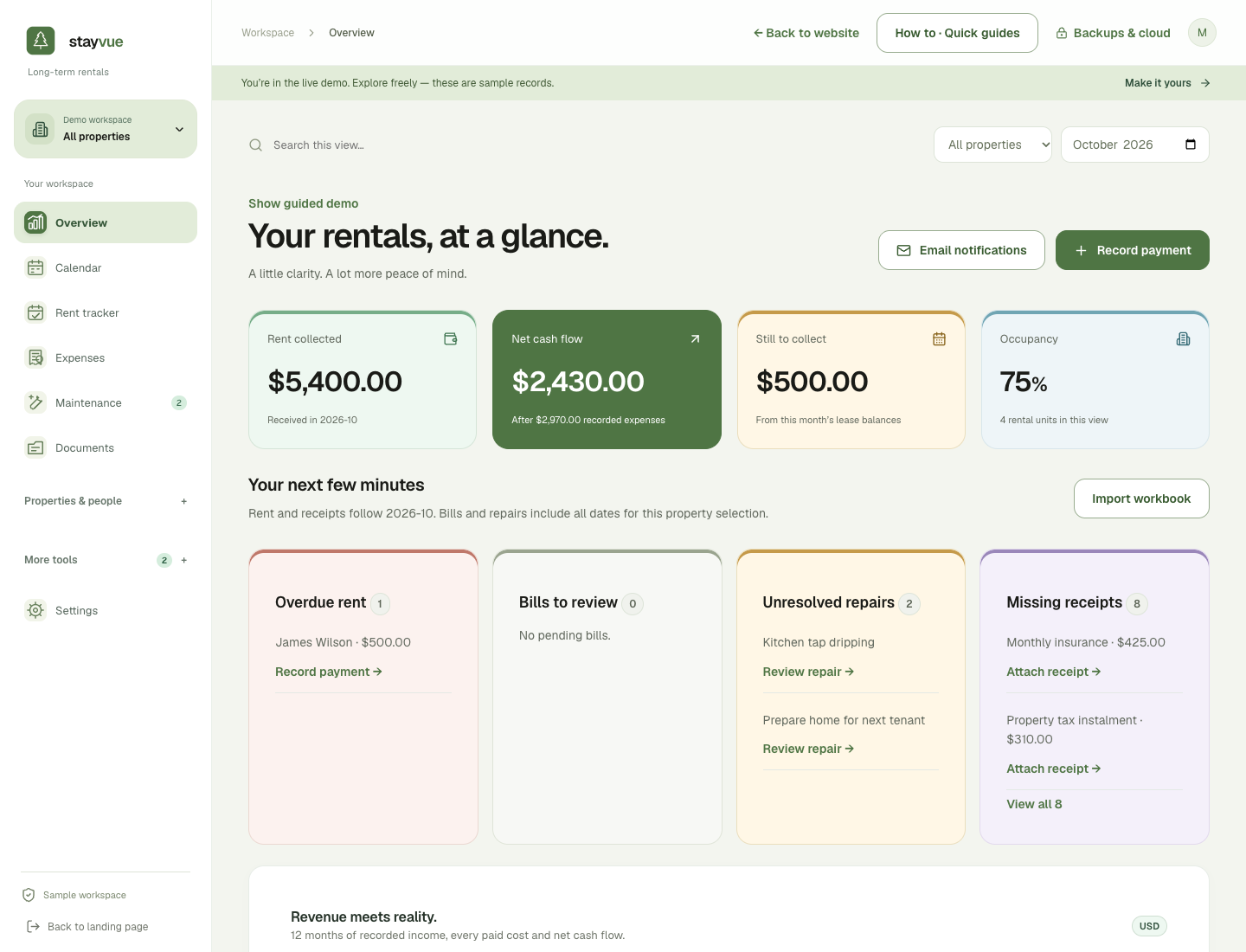
Match recorded payments to bank activity, investigate duplicates, attach missing proof and review outstanding rent. Compare the month with the same property in earlier months before drawing conclusions. A large repair can explain a one-month dip without indicating a lasting trend. In StayVue, Overview separates recorded cash flow from the rent balance and shows the categories behind total costs.
- Confirm the two rent receipts total $2,000 and both belong to September.
- Match the $800 mortgage payment to the statement; keep the $450 principal and $350 interest distinguishable without entering the total again.
- Match the other payments to their receipts: $200 + $100 + $150 = $450.
- Check cash flow: $2,000 − $800 − $450 = $750. Keep unpaid rent and unpaid invoices separate from this cash total.
- List missing evidence or unresolved differences before handing records to your accountant.
Prepare the rental accountant handoff · Save an external backup of your rental records
Put it into practice.
Explore a sample rental workspace. No sign-up is needed for the demo.
Explore StayVue